D&D 4e Draconomicon Metallic Dragons Pdf Download
| D | |
|---|---|
| D d | |
| (See below) | |
 | |
| Usage | |
| Writing organisation | Latin script |
| Type | Alphabetic |
| Language of origin | Latin linguistic communication |
| Phonetic usage |
|
| Unicode codepoint | U+0044, U+0064 |
| Alphabetical position | 4 Numerical value: four |
| History | |
| Development |
|
| Time period | ~-700 to present |
| Descendants |
|
| Sisters |
|
| Variations | (Run across below) |
| Other | |
| Other letters ordinarily used with | d(ten) |
| Associated numbers | 4 |


D, or d, is the quaternary letter of the modern English language alphabet and the ISO basic Latin alphabet. Its name in English is dee (pronounced ), plural dees.[one]
History
| Egyptian hieroglyph door, fish | Phoenician daleth | Greek Delta | Etruscan D | Latin D |
|---|---|---|---|---|
| |  |  |  |  |
The Semitic letter Dāleth may have developed from the logogram for a fish or a door.[2] At that place are many dissimilar Egyptian hieroglyphs that might have inspired this. In Semitic, Ancient Greek and Latin, the letter represented /d/; in the Etruscan alphabet the letter was superfluous merely even so retained (see letter B). The equivalent Greek letter is Delta, Δ.
Compages
The minuscule (lower-case) grade of 'd' consists of a lower-story left basin and a stem ascender. It developed by gradual variations on the majuscule (capital) form 'D', composed of a stem with a full lobe to the right. In handwriting, it was common to starting time the arc to the left of the vertical stroke, resulting in a serif at the top of the arc. This serif was extended while the rest of the letter was reduced, resulting in an angled stroke and loop. The angled stroke slowly developed into a vertical stroke.
Use in writing systems
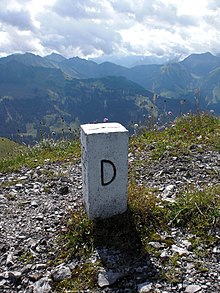
In near languages that utilize the Latin alphabet, and in the International Phonetic Alphabet, ⟨d⟩ more often than not represents the voiced alveolar or voiced dental plosive /d/. However, in the Vietnamese alphabet, it represents the sound /z/ in northern dialects or /j/ in southern dialects. (Meet D with stroke and Dz (digraph).) In Fijian it represents a prenasalized terminate /nd/.[3] In some languages where voiceless unaspirated stops contrast with voiceless aspirated stops, ⟨d⟩ represents an unaspirated /t/, while ⟨t⟩ represents an aspirated /tʰ/. Examples of such languages include Icelandic, Scottish Gaelic, Navajo and the Pinyin transliteration of Mandarin.
Other uses
- The Roman numeral D represents the number 500.[4]
- D is the grade below C simply above E in the school grading system.
- D is the International vehicle registration code for Germany (see too .de).
- In Cantonese: Considering the lack of Unicode CJK back up in the early figurer system, many Hong Kongers and Singaporeans used the capitalized D to represent 啲 (lit. a little).
- d. is the standard abridgement for the Penny (British pre-decimal money) (from Latin: denarius)
- Ɖ ɖ : African D
- Ð ð : Latin letter Eth
- D with diacritics: Đ đ Ꟈ ꟈ[5] Ɗ ɗ Ḋ ḋ Ḍ ḍ Ḑ ḑ Ḓ ḓ Ď ď Ḏ ḏ ᵭ[6] ᶁ[vii] ᶑ[7]
- IPA-specific symbols related to D: ɖ
- Ꝺ ꝺ : Insular D is used in various phonetic contexts[8]
- ᴅ D d : Small majuscule D and various modifier messages are used in the Uralic Phonetic Alphabet.[9]
- ȡ : D with ringlet is used in Sino-Tibetanist linguistics[ten]
- Ƌ ƌ : D with topbar
Ancestors and siblings in other alphabets
- 𐤃 : Semitic letter Dalet, from which the post-obit symbols originally derive
- Δ δ : Greek letter Delta, from which the following symbols originally derive
- Ⲇ ⲇ : Coptic letter Delta
- Д д : Cyrillic letter De
- 𐌃 : Old Italic D, the antecedent of modernistic Latin D
- ᛞ : Runic letter dagaz, which is perchance a descendant of Old Italic D
- ᚦ Runic alphabetic character thurisaz, another possible descendant of Quondam Italic D
- 𐌳 : Gothic letter daaz, which derives from Greek Delta
- Δ δ : Greek letter Delta, from which the following symbols originally derive
Derived signs, symbols and abbreviations
- ₫ : Đồng sign
- ∂ : the partial derivative symbol,

Calculating codes
| Preview | D | d | ||
|---|---|---|---|---|
| Unicode name | LATIN Uppercase Letter D | LATIN SMALL Letter of the alphabet D | ||
| Encodings | decimal | hex | dec | hex |
| Unicode | 68 | U+0044 | 100 | U+0064 |
| UTF-8 | 68 | 44 | 100 | 64 |
| Numeric character reference | D | D | d | d |
| EBCDIC family unit | 196 | C4 | 132 | 84 |
| ASCII one | 68 | 44 | 100 | 64 |
- i Also for encodings based on ASCII, including the DOS, Windows, ISO-8859 and Macintosh families of encodings.
Other representations
In British Sign Linguistic communication (BSL), the letter 'd' is indicated by signing with the right hand held with the index and thumb extended and slightly curved, and the tip of the thumb and finger held against the extended index of the left paw.
References
- ^ "D" Oxford English Lexicon, 2nd edition (1989); Merriam-Webster's Third New International Dictionary of the English Language, Entire (1993); "dee", op. cit.
- ^ "The letter of the alphabet D". issuu. Archived from the original on 2021-08-29. Retrieved 2021-07-06 .
- ^ Lynch, John (1998). Pacific languages: an introduction. Academy of Hawaii Press. p. 97. ISBN0-8248-1898-9.
- ^ Gordon, Arthur E. (1983). Illustrated Introduction to Latin Epigraphy . University of California Printing. pp. 44. ISBN9780520038981 . Retrieved three Oct 2015.
roman numerals.
- ^ Everson, Michael; Lilley, Chris (2019-05-26). "L2/19-179: Proposal for the addition of four Latin characters for Gaulish" (PDF).
- ^ Constable, Peter (2003-09-xxx). "L2/03-174R2: Proposal to Encode Phonetic Symbols with Centre Tilde in the UCS" (PDF).
- ^ a b Constable, Peter (2004-04-xix). "L2/04-132 Proposal to add additional phonetic characters to the UCS" (PDF).
- ^ Everson, Michael (2006-08-06). "L2/06-266: Proposal to add together Latin letters and a Greek symbol to the UCS" (PDF).
- ^ Everson, Michael; et al. (2002-03-20). "L2/02-141: Uralic Phonetic Alphabet characters for the UCS" (PDF).
- ^ Cook, Richard; Everson, Michael (2001-09-20). "L2/01-347: Proposal to add vi phonetic characters to the UCS" (PDF).
External links
 | Wikimedia Eatables has media related to D. |
DOWNLOAD HERE
Posted by: saundersfroffelf.blogspot.com


0 Komentar
Post a Comment